
Comparisons
Fractional CMO vs Marketing Agency: How to Choose
Compare strategic leadership, execution, ownership and cost structure when deciding between a fractional CMO and a marketing agency.
Direct answer. A fractional CMO generally supplies part-time senior marketing leadership; an agency generally supplies a team or defined delivery capacity. The better choice depends on who will set priorities, who will execute them, who owns decisions and what internal team already exists. Some businesses need both, or a partner that combines leadership and implementation.
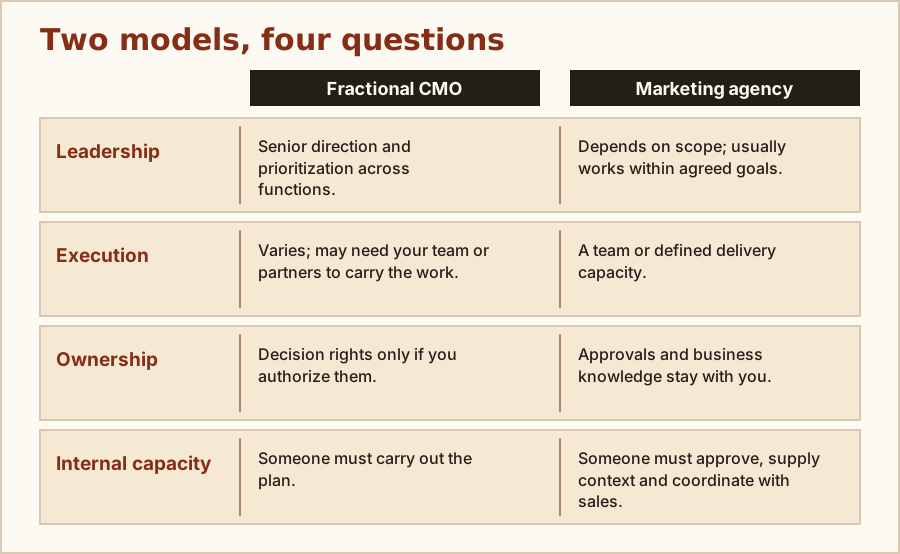
These labels are broad. Contracts differ, so compare a real scope of work rather than assuming a title guarantees capabilities.
| Decision factor | Fractional CMO | Marketing agency |
|---|---|---|
| Main contribution | Senior direction, prioritization and cross-functional leadership | Specialist execution or a defined service program |
| Typical internal dependency | Someone must execute unless the engagement includes a team | Someone must own approvals, business knowledge and sales coordination |
| Decision rights | Can be embedded in leadership decisions if authorized | Usually works within agreed goals, scope and approval process |
| Delivery capacity | Varies by individual and supporting network | Varies by staffing, service mix and contract |
| Common risk | A strong plan with no implementation capacity | A busy execution program without clear business priorities |
| What to ask for | Decision cadence, owners, roadmap and implementation support | Named team, actual deliverables, handoffs, reporting and scope boundaries |
Start with the missing capability
If the business has capable channel specialists but no one can decide which initiatives matter, leadership may be the immediate gap. If priorities are clear and work is stalled by limited production capacity, an execution team may fit. If both strategy and execution are disconnected, ask each provider to show how decisions turn into shipped work and how sales outcomes feed back into the plan.
Compare the total operating model
Write down the cost of the provider plus internal time, software and any separately hired specialists. Ask who owns analytics, website changes, campaign approvals, CRM data quality and sales handoff. Confirm the cadence for changing priorities and what the business will own after the engagement ends. Published list prices, when available, rarely describe the whole scope; get a proposal tied to actual responsibilities.
When an integrated partner can fit
An integrated partner can reduce handoffs when the work spans positioning, acquisition, website, follow-up and attribution. It can also create dependence on one provider, so require clear documentation, access to accounts and data, and a practical transition plan. Vaquero's growth strategy service is designed around diagnosis and sequenced implementation; review the Tame, Build, Scale process and ask what work Vaquero itself will own in your situation.
Questions for every candidate
Ask for a specific first 90-day plan, the people who will do the work, business inputs needed from you, deliverables, limitations, a measurement definition and examples you can verify. A provider should be able to explain what it would not recommend yet. If the immediate question is where your current acquisition-to-revenue system is failing, schedule a strategy call.
Disclosure: Vaquero Marketing offers growth strategy and related implementation services and is a potential provider in this comparison. The decision framework is general; it does not establish that Vaquero is the right fit for every business.