
Guides
Marketing Attribution From Click to Qualified Review
Map first contact through qualified review and closed revenue with consistent source capture, CRM stages and documented attribution limits.
Direct answer. A useful attribution system connects the source of a visit to a stable lead record, a completed and qualified business review, an opportunity and a final outcome. Capture the evidence at each transition and preserve uncertainty when the source cannot be known. Choose budget using qualified pipeline, not only form counts.
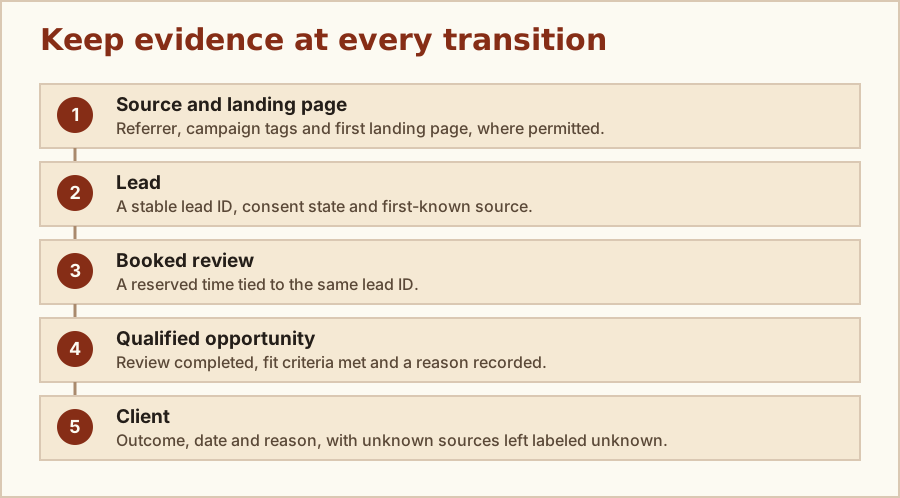
Many businesses can identify which campaign received a click but cannot tell whether the resulting contact became a real sales conversation. The missing link is often the handoff among website form, calendar and CRM. Begin with a simple event map before choosing an attribution model.
Define the stages once
Use terms your sales team can apply consistently:
- Inquiry: a person submitted a form, called or otherwise contacted the business.
- Review booked: a specific time was reserved and tied to a lead ID.
- Review completed: the conversation actually occurred.
- Qualified: fit criteria were met and a reason was recorded.
- Opportunity: a potential engagement and owner were created in the CRM.
- Outcome: proposal, won, lost, or disqualified with date and reason.
Each stage should have a timestamp and a unique record. A calendar opening is not a booking; a booking is not a completed review. Define the denominator before reporting conversion rates.
Capture the minimum useful source data
At the first meaningful contact, preserve landing page, referrer when available, campaign tags, click IDs where permitted, form or call source, and consent state. Carry an internal lead ID into the calendar and CRM. Keep first-known and latest-known source separately when the business needs both. Do not overwrite an earlier source every time someone returns directly to the site.
Review the privacy policy, analytics consent and platform settings before adding identifiers. Some journeys cross devices, lose referrers or begin offline. Label them unknown or self-reported; a precise-looking but invented source is worse than an honest gap.
Reconcile the handoffs
Once a week, compare website submissions with CRM leads and calendar bookings, and sample records through qualification. Track the percentage of records with a usable source and the percentage with a completed outcome; these coverage measures show whether a channel-level conclusion is reliable. The lead response audit gives the full test-lead procedure for finding missing IDs, duplicates and dropped webhooks.
Make a budget decision with limits visible
Compare channels by qualified reviews and opportunities, then add acquisition cost and revenue when those inputs are complete. If attribution coverage is poor, use the data to identify operational fixes before reallocating major spend. Do not claim one touch caused a sale merely because it was the only recorded touch.
Vaquero's growth strategy joins channel priorities to conversion and CRM operations. The marketing ROI solution addresses the broader systems problem. To review a specific source-to-revenue gap, schedule a strategy call.
Limit: This is an operating framework. It does not determine the correct attribution model for every business or solve privacy, offline identity and multi-device gaps by itself.