
Guides
Why Website Traffic Does Not Become Qualified Leads
A practical diagnosis of intent, messaging, conversion friction and lead handoff when website visits do not become useful sales conversations.
Direct answer. Traffic can fail to create qualified leads at several different points: the visitors may not be buyers, the page may answer the wrong question, the offer may be unclear, the form may add friction, or the lead may be lost after submission. Diagnose each handoff before changing the headline or buying more traffic.
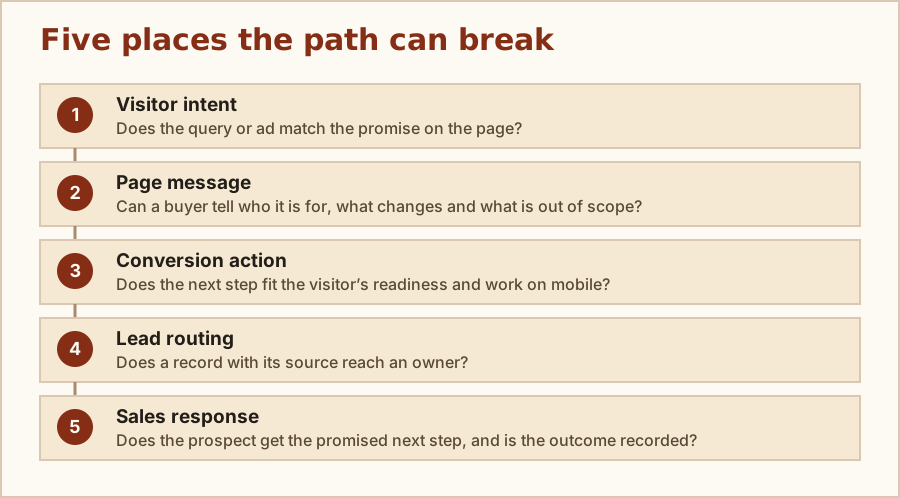
A traffic report can show that people arrived. It cannot, by itself, show whether the right person understood the offer, requested the next step, received a response and became a genuine opportunity. For an established business, the practical unit is a qualified conversation linked back to the page and source that helped create it.
First, define a qualified lead
Agree on a small set of observable criteria with sales: problem and service fit, business scope, decision role, timing and ability to take the next step. Record why a lead is accepted or rejected. A large number of submissions with no fit is a different problem from a page with no submissions at all. Do not label every download or automated score as a qualified lead.
Trace the path in five stages
1. Search or campaign intent. Compare the query, ad or referring context with the promise on the landing page. A visitor researching a definition needs an answer and a sensible path forward; a visitor requesting a provider needs evidence, fit and an easy way to talk. If these audiences share a page, make their next steps distinct.
2. Message and proof. Can a buyer tell who the offer is for, what changes, how the work proceeds and what is outside scope? Use verified examples when available. If proof is still being collected, show the actual method and deliverables without manufacturing results.
3. Conversion action. Review the mobile experience, button hierarchy, form fields, errors and confirmation state. The primary action should match the visitor's readiness. A useful diagnostic can serve research visitors while a strategy call serves decision-ready buyers. Test with a real device and keyboard, not just a desktop screenshot.
4. Routing and response. Submit a test lead and confirm it reaches an owner and receives the promised next step. The lead response audit gives the full procedure. A form conversion without a working handoff is not a business result.
5. Opportunity measurement. Join landing page and source to booked meeting, completed review, qualified status, proposal and closed business. Mark missing data as unknown rather than assigning a channel credit by guesswork.
How to choose the first fix
If the page has impressions but little relevant traffic, inspect query intent and search presentation. If relevant visitors arrive but few take action, review message, proof and friction. If forms arrive but reviews are not completed, inspect calendar and follow-up. If reviews happen but do not qualify, revisit targeting, offer and qualification. Change one major bottleneck at a time and record what was changed.
What a website project should cover
A conversion-focused website connects page architecture and design to the downstream system. It should specify the intended visitor, the information needed to decide, the action, and the record that proves the action reached sales. Funnels and conversion handle the transition for different visitor intents. For a directional self-check, use the Growth System Score; for a business-specific discussion, schedule a strategy call.
Limit: This framework locates likely leaks. It does not diagnose any specific business without access to its analytics, CRM, traffic sources and actual lead dispositions.